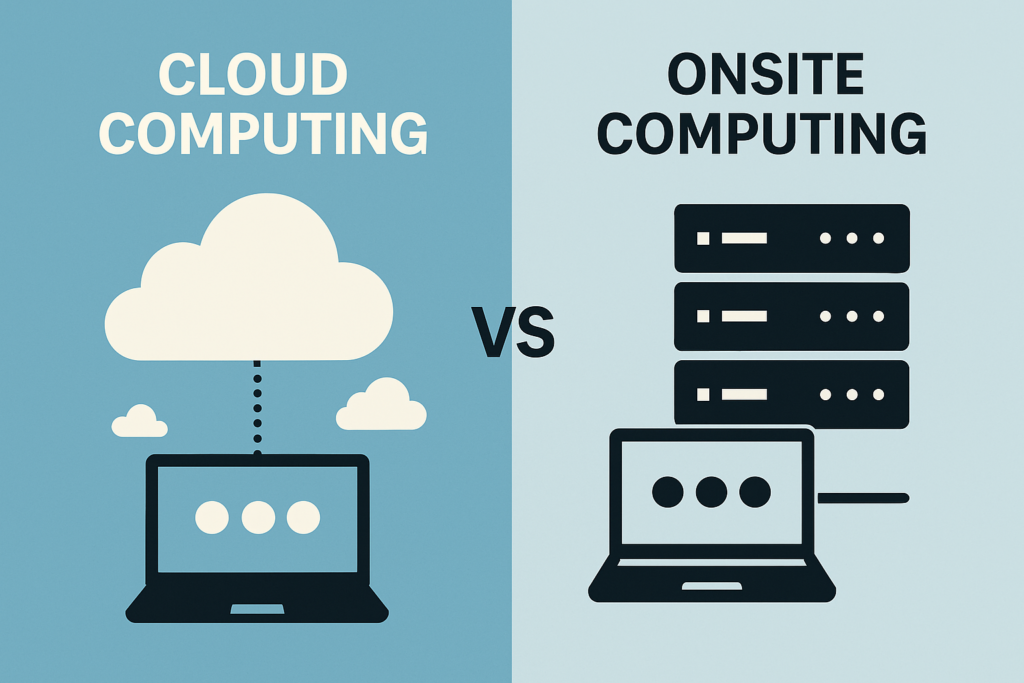
The way enterprises run computing workloads has undergone two major architectural revolutions in the past two decades. The first was the shift from mainframes to distributed on-premises (local) servers in the 1990s and early 2000s. The second – far more consequential for artificial intelligence – was the shift from those local, on-premises servers to cloud computing beginning around 2006 with Amazon Web Services (AWS) and accelerating through Microsoft Azure (2010) and Google Cloud Platform (2011).
Today, in 2025, that second revolution has reached an inflection point: cloud computing is no longer just about cost savings or elasticity; it has become the essential substrate that enables powerful AI agents and AI assistants to dynamically create, deploy, and manage custom applications that can fundamentally transform an enterprise.
To understand why this transformation is only feasible at scale in the cloud, we must first examine the deep technical and economic differences between the two paradigms.
Core Architectural Differences
| Dimension | Local / On-Premises Serving | Cloud Computing |
|---|---|---|
| Infrastructure ownership | You buy, house, power, cool, and maintain everything | Provider owns and operates planet-scale data centers |
| Upfront cost | Massive CAPEX (servers, networking, storage, licenses) | Pay-as-you-go OPEX; near-zero upfront cost |
| Scalability | Vertical (bigger servers) or painful horizontal scaling | Instant, API-driven horizontal scaling to millions of cores |
| Elasticity | Weeks or months to add capacity | Seconds to minutes via auto-scaling groups |
| Geographic reach | Limited to your physical locations | 30+ regions, 100+ availability zones worldwide |
| Maintenance & patching | Your team does everything | Provider handles hardware, hypervisor, OS patching |
| Access to cutting-edge hardware | 12–36 month refresh cycle | Immediate access to latest GPUs (H100, Blackwell, etc.) |
| API ecosystem | Limited or custom-built | Rich, standardized APIs for every layer of the stack |
These differences compound dramatically when you introduce modern AI workloads.2. Why AI Agents and AI Assistants Need Cloud-Native InfrastructureModern AI agents (autonomous systems that can reason, plan, use tools, and execute multi-step tasks) and AI assistants (interactive co-pilots such as Claude, Grok, or custom enterprise GPTs) are fundamentally different from traditional software:
- They are non-deterministic and experimental by nature – you often need dozens or hundreds of inference runs to get the right output.
- They consume massive amounts of GPU memory and compute during both training/fine-tuning and inference.
- They are highly stateful and long-running (an agent working on a month-long M&A due-diligence task may keep context for weeks).
- They frequently call external tools, APIs, and databases in real time.
- They often spawn sub-agents or parallel workflows.
None of these characteristics map well to traditional on-premises infrastructure.
The GPU Imperative
Training or fine-tuning even a modest 7B–70B parameter model today requires clusters of modern GPUs (NVIDIA H100, B200, or AMD MI300X). A single 8×H100 server costs ≈$300,000–$400,000 plus power/cooling. Most enterprises cannot justify purchasing and maintaining such clusters for intermittent use.
Cloud providers, by contrast, offer on-demand access to tens of thousands of the latest GPUs, rentable by the second.
Elastic Burst Capacity
An AI agent tasked with “scrape and summarize every public filing our top 50 competitors made in the last 24 hours” may suddenly require 500 parallel LLM calls and vector database lookups. In the cloud, the agent can spin up 500 containers or serverless functions in <30 seconds, complete the task in minutes, and then shut everything down – paying only for actual compute time. On-premises, that workload either waits weeks for hardware or simply fails.
Global, Low-Latency Presence
An international retailer’s AI pricing agent needs to react in <200 ms when a competitor in Singapore drops prices. Cloud providers have edge locations and regions in nearly every major market. An on-premises solution would require the company to build its own global private fiber network – effectively impossible.
Managed Services and Tooling Ecosystem
Cloud platforms now offer hundreds of AI-specific managed services (Amazon Bedrock, Azure OpenAI Service, Google Vertex AI, Anthropic/Claude on Bedrock, Cohere, Mistral, Grok API, etc.). An AI agent can programmatically:
- Provision a new fine-tuned model in minutes
- Create vector databases (Pinecone, Weaviate, PGVector on Supabase/Alloy)
- Spin up real-time WebSocket endpoints
- Deploy serverless functions in 50+ runtimes
- Connect to thousands of third-party APIs via platforms like Zapier or custom tool calling
All of these actions are performed via API calls that the agent itself can make autonomously.3. How Cloud Enables AI Agents to Build Custom Applications AutonomouslyThe killer feature of 2025-era AI agents is not just that they can answer questions – it is that they can write, deploy, and operate entire applications with minimal or zero human intervention.
A concrete example from a large insurance company in 2024–2025:Business goal: “Reduce policy underwriting time from 5 days to under 4 hours for small commercial risks.
”Traditional approach (local): 18-month IT project, $4–8 million budget, custom Java/.NET application, on-prem servers. Cloud + AI agent approach (2025):
- Product owner tells an AI agent (running on Grok-4/Claude 3.5/Gemini 2.0):
“Build a fully automated underwriting workbench for risks under $5 M revenue.” - The agent:
- Analyzes hundreds of historical underwriting decisions
- Fine-tunes a reasoning model on Bedrock/Vertex with the company’s proprietary guidelines
- Uses retrieval-augmented generation (RAG) against the full policy manual
- Generates a Next.js + Tailwind frontend
- Writes FastAPI/Python backend with Pydantic validation
- Deploys everything via Terraform to AWS/GCP in a new account sandbox
- Sets up CI/CD with GitHub Actions
- Creates monitoring dashboards in Datadog
- Writes unit tests and runs them
- Submits the entire application for human code review (which takes 20 minutes instead of months)
Total time from request to production-ready system: 9 hours of agent work + 3 hours of human oversight.The business impact:
- Underwriting capacity increased 6× with the same headcount
- Loss ratio improved 180 bps because decisions became more consistent
- New digital channel brought in $180 million of incremental premium in the first year
This is only possible because every single action the agent took (provisioning GPUs for fine-tuning, creating IAM roles, deploying containers, registering domains, etc.) is exposed as an API in the cloud provider’s control plane.4. The Emerging “Agent-Native” Enterprise Stack (2025)Leading enterprises are now assembling what analysts call the agent-native stack:
- Foundation models: Grok-4, Claude 3.5 Sonnet, Gemini 2.0 Flash Thinking, Llama 405B, Mistral Large 2
- Orchestration & memory: LangGraph, CrewAI, Autodesk, or custom state machines
- Long-term memory: Vector stores (Pinecone, Zilliz, Qdrant) + graph databases (Neo4j, Memgraph)
- Tool calling & function execution: Cloud provider serverless functions (AWS Lambda, GCP Cloud Run, Azure Container Apps)
- Identity & access: Cloud IAM + Workload Identity Federation so agents can act on behalf of users
- Observability: LangSmith, Phoenix, Helicone, Braintrust
- Deployment: Vercel, Render, Fly.io, or full Kubernetes for heavy workloads
Every layer is cloud-native, API-driven, and pay-per-use.5. Residual Advantages of Local Serving (and Why They Are Shrinking)There remain a few niches where on-premises or local-edge serving still wins:
- Air-gapped defense or intelligence environments
- Extreme low-latency trading (<5 μs)
- Regulatory requirements that prohibit data egress (increasingly rare as sovereign clouds proliferate)
Even in these cases, the industry trend is toward “cloud-like” on-premises offerings (Azure Stack, AWS Outposts, Google Anthos) that bring the same APIs and tooling inside the customer’s four walls.ConclusionThe difference between cloud computing and local serving is no longer just about cost or convenience.
At a deeper architectural level, cloud computing has created a global, programmable computational fabric that exposes every resource – from a single GPU hour to an entire virtual private cloud – as an API endpoint.
This API-first, infinitely elastic fabric is the only environment in which autonomous AI agents can truly flourish. Only in the cloud can an agent spin up a 64-GPU cluster for five minutes to fine-tune a model, deploy a hundred microservices, query petabytes of data, and then tear everything down – all without human intervention and at a cost of a few hundred dollars.
The enterprises that understand this are no longer asking “Should we move to the cloud?” They are asking “How fast can we give our AI agents the keys to the entire cloud control plane?”
Those who master that handoff will find that their competitive moat is no longer measured in servers or even in software – it is measured in how effectively their AI agents can reprogram the company’s digital nervous system in real time to pursue any new goal.
In 2025 and beyond, the winners will be the companies whose infrastructure is not a fixed asset but a liquid extension of artificial intelligence itself. And that liquidity is only possible in the cloud.