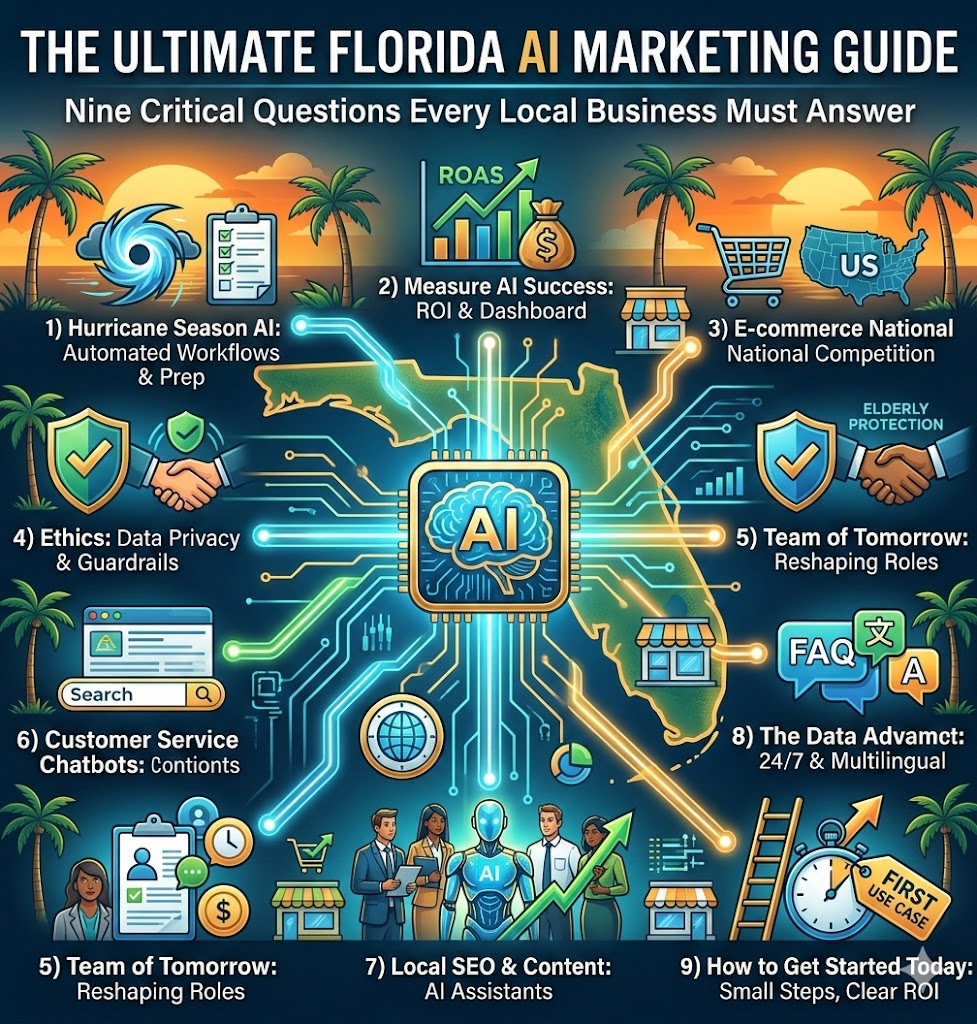
How does AI marketing change during Florida’s hurricane season?
Smart Florida marketers build hurricane-triggered AI workflows in advance. These automatically pause irrelevant promotions, activate emergency service ads, deploy storm-prep content, and shift email messaging — all within minutes of a storm threat. Businesses that plan for this outperform competitors who react manually too late.
How Does AI Marketing Change During Florida’s Hurricane Season?
Hurricane season in Florida is not merely a weather phenomenon — it is an economic, social, and operational reality that shapes every aspect of how businesses plan, communicate, and serve their communities from June 1 through November 30. For six months of every year, Florida businesses operate under the shadow of a potential catastrophic disruption that can materialize with as little as 72 hours of meaningful warning and reshape entire regional economies in a matter of hours.
For Florida marketers, hurricane season presents one of the most complex and consequential challenges in American business — and AI marketing, applied thoughtfully and prepared in advance, represents the most powerful tool available for navigating it effectively.
The Pre-Season Preparation Imperative
The single most important hurricane season AI marketing insight is deceptively simple: the businesses that perform best during and after storm events are those that built and tested their AI marketing response systems before the season began — not those scrambling to react after a storm has already formed in the Gulf.
This means that every May, Florida businesses with serious AI marketing operations should be conducting what might be called a hurricane marketing drill. Pre-building campaign assets for multiple storm scenarios. Writing and storing email templates for storm preparation, business closure, reopening, and community support messaging. Configuring AI-powered automation rules that trigger specific communications based on defined weather events. Testing chatbot responses for storm-related customer inquiries. Updating Google Business Profile with emergency hours protocols. Building social media content libraries for rapid storm-response deployment.
The businesses that do this work in May are the ones posting calm, organized, brand-consistent communications within hours of a storm threat. The ones that don’t are posting panicked, typo-filled Facebook updates at midnight while simultaneously trying to board up their windows.
AI-Triggered Campaign Automation
Modern marketing automation platforms — HubSpot, Klaviyo, ActiveCampaign, Salesforce Marketing Cloud — can be configured with weather-triggered automation rules using API integrations with weather data services like Weather.com or the National Hurricane Center’s data feeds. When a named storm enters a defined geographic watch zone, pre-built automation sequences activate automatically.
For a Florida home improvement retailer, this might mean an automatic email campaign to their customer list highlighting generator inventory, hurricane shutters, and emergency supply availability — triggered the moment a tropical storm reaches Category 1 status within 500 miles of their store locations. For a restaurant chain, it might mean an automated social media post sequence about modified hours, followed by a reopening announcement sequence configured to deploy based on local power restoration signals. For a vacation rental company, it means an automated communication flow to guests with upcoming reservations — acknowledging the storm, providing clear policy information, and offering rebooking options — deployed without requiring any staff member to manually manage hundreds of individual guest communications during a period of maximum operational chaos.
The Pause-and-Pivot Protocol
One of the most important and most frequently overlooked aspects of hurricane season AI marketing is knowing what to stop — not just what to start. Florida businesses running ongoing paid advertising campaigns, email marketing sequences, and social media promotional content need AI-powered systems that pause or modify all promotional marketing automatically when a storm threat reaches defined severity thresholds.
The reputational damage from running a cheerful “Summer Sale — 20% Off All Items!” ad campaign while a Category 4 hurricane is bearing down on your community is severe and lasting. Florida consumers have long memories for brands that appeared tone-deaf or exploitative during storm events — and social media amplifies these failures instantly and mercilessly.
AI marketing systems configured with clear storm-response protocols automatically pause promotional campaigns, switch to community-support messaging, and resume normal marketing only when pre-defined all-clear conditions are met. This automation removes the human error risk during a period when your team is personally dealing with the same storm your customers are facing.
Post-Storm Community Marketing and Rebuilding
The post-storm marketing environment in Florida requires its own sophisticated approach. Communities recovering from significant hurricane damage are not in a frame of mind to receive normal promotional marketing — but they do need to know which businesses are open, which services are available, and which companies are actively supporting community recovery.
AI-powered local marketing tools — Google Business Profile updates, local search ad campaigns, community-focused social media content — can be pre-configured to activate in the post-storm window with messaging specifically calibrated for recovery contexts. Home services companies can deploy AI-optimized campaigns highlighting emergency repair services. Restaurants that reopened can use AI-powered local search ads to reach residents and recovery workers seeking open food options. Financial services companies can deploy educational content about insurance claims and disaster assistance programs.
The businesses that emerge from Florida hurricane seasons with strengthened community relationships and expanded customer bases are invariably those that used AI marketing to be genuinely helpful, rapidly responsive, and consistently present throughout the storm cycle — from preparation through recovery. In a state where hurricane season is simply the cost of doing business in paradise, that marketing infrastructure is not optional. It is essential.
How do Florida businesses measure whether their AI marketing is actually working?
Track metrics tied to revenue: cost per lead, conversion rate, customer acquisition cost, and return on ad spend (ROAS). AI dashboards in platforms like HubSpot or Google Analytics 4 make this easier. The question isn’t “is AI busy?” — it’s “is AI producing customers profitably?”
How Do Florida Businesses Measure Whether Their AI Marketing Is Actually Working?
There is a particular kind of Florida business owner who has adopted AI marketing tools enthusiastically, is spending money on several platforms, receives weekly automated reports full of charts and metrics — and has absolutely no idea whether any of it is actually growing their business. The dashboards look impressive. The AI is clearly busy. But the connection between marketing activity and business results remains frustratingly opaque.
This measurement challenge is not unique to Florida businesses, but it has particular urgency in a competitive state where marketing budgets for small and mid-sized businesses are often tight, the cost of misallocated marketing spend is high, and the proliferation of AI tools has created a genuine risk of paying for impressive-sounding technology that doesn’t actually move the needle on revenue.
Measuring AI marketing effectiveness requires clarity on three things that most Florida businesses have not explicitly defined: what success actually looks like for their specific business, which metrics genuinely connect to that success, and how to isolate AI’s contribution from other variables affecting business performance.
Starting With Business Outcomes, Not Marketing Metrics
The most common measurement mistake Florida businesses make is tracking marketing metrics — impressions, clicks, email open rates, social media followers, website sessions — without connecting them to business outcomes. These metrics are not without value, but they are means to an end, not the end itself. A Florida restaurant with 50,000 Instagram followers and a 45% email open rate that isn’t filling tables on Tuesday nights has a marketing problem despite impressive vanity metrics.
The foundation of effective AI marketing measurement is defining your business outcomes first and working backward to the marketing metrics that genuinely predict those outcomes for your specific business. For a Florida vacation rental company, the ultimate business outcome is revenue per available night. The marketing metrics that connect to that outcome include direct booking conversion rate, cost per booking, repeat guest rate, and average booking window length. Everything else is context, not signal.
For a Florida personal injury law firm, the outcome is signed retainer agreements. The connecting metrics are cost per qualified lead, lead-to-consultation conversion rate, and consultation-to-retainer conversion rate. For a Florida medical spa, the outcome is revenue per patient. The connecting metrics are new patient acquisition cost, treatment revenue per visit, and patient retention rate at 90 and 180 days.
Once these outcome-to-metric chains are clearly defined, AI marketing measurement becomes dramatically more straightforward — and the AI tools you invest in can be evaluated specifically on whether they move the metrics that actually connect to your business results.
Attribution: Florida’s Multi-Channel Measurement Challenge
Florida businesses marketing to seasonal and tourist audiences face a particularly complex attribution challenge. A snowbird couple from Michigan might first discover your Naples restaurant through a Google search in September, see your Instagram content through October and November, receive a promotional email in late October, and finally make a reservation in mid-November when they arrive in Florida. Which marketing touchpoint gets credit for that booking?
Traditional last-click attribution — crediting the final touchpoint before conversion — would give full credit to whatever channel they used to make the reservation, ignoring the five previous touchpoints that built awareness and intent. AI-powered multi-touch attribution models, available in platforms like Google Analytics 4, HubSpot, and Triple Whale, distribute credit across all touchpoints in the customer journey using machine learning to weight each touchpoint’s actual contribution to the ultimate conversion.
For Florida businesses with complex, multi-channel customer journeys — particularly those marketing to seasonal visitors who research months in advance — this multi-touch attribution capability represents a genuinely meaningful improvement in marketing intelligence. It reveals which channels are building awareness and intent early in the journey versus which are closing conversions — allowing smarter budget allocation across the full funnel.
The Control Group Approach
One of the most rigorous and underutilized methods for measuring AI marketing effectiveness is the control group experiment — running AI-powered marketing to one segment of your customer base while maintaining traditional approaches with a comparable segment, then measuring the difference in outcomes between the two groups over a defined period.
A Florida auto dealership testing AI-powered lead nurturing sequences, for example, might implement the AI system for leads generated in odd-numbered zip codes while maintaining traditional phone-based follow-up for leads from even-numbered zip codes. After 90 days, comparing lead-to-sale conversion rates, revenue per lead, and sales cycle length between the two groups provides clear, controlled evidence of AI’s actual impact — not correlation, but genuine causal measurement.
This approach requires discipline and patience, but for Florida businesses making significant AI marketing investments, it is the gold standard for understanding what the technology is actually delivering.
Building a Florida AI Marketing Scorecard
The practical implementation of AI marketing measurement for most Florida businesses should take the form of a simple, regularly reviewed scorecard — a dashboard containing no more than 5 to 8 metrics directly connected to business outcomes, reviewed weekly or monthly with a consistent methodology.
For a Florida luxury real estate brokerage, this scorecard might include: cost per qualified lead by channel, lead-to-showing conversion rate, showing-to-offer conversion rate, average days from lead to closed transaction, and revenue per marketing dollar spent. Every AI marketing decision — which tools to invest in, which campaigns to scale, which channels to cut — is evaluated against movement in these specific metrics.
The Florida businesses that measure AI marketing most effectively are not the ones with the most sophisticated analytics stacks. They are the ones with the clearest definition of what success looks like, the discipline to track only the metrics that connect to that success, and the willingness to make hard investment decisions based on what the data actually shows rather than what the marketing dashboards make look impressive.
What AI tools are Florida marketing agencies using most in 2024–2025?
Top tools include ChatGPT/Claude for content, Jasper for copywriting, Midjourney for visuals, HubSpot AI for CRM, Google Performance Max and Meta Advantage+ for paid ads, and Semrush AI for SEO. Most Florida agencies now blend several tools rather than relying on any single platform.
What AI Tools Are Florida Marketing Agencies Using Most in 2025?
Florida’s marketing agency landscape has undergone a faster and more dramatic transformation in the past three years than in the previous two decades combined. From the boutique digital agencies of Wynwood to the full-service shops of Tampa Bay to the tourism-specialist firms of Orlando, AI tools have fundamentally restructured how agencies work, what they charge for, and what value they deliver to Florida business clients.
Understanding which AI tools Florida’s most sophisticated marketing agencies are actually using — not just what they’re promoting in their own marketing — gives Florida business owners both a benchmark for evaluating agency partners and a roadmap for building internal marketing capabilities that can compete with professional agency output.
The AI Content and Creative Stack
Content production has historically been one of the most time-intensive and staff-heavy functions in marketing agency operations. Florida agencies producing blogs, email campaigns, social media content, ad copy, and website text for dozens of clients simultaneously have embraced AI writing tools as a fundamental operational efficiency — and the quality ceiling of these tools has risen dramatically.
ChatGPT and Claude have become the most widely used AI writing assistants in Florida agency operations — used for everything from first-draft blog posts and email subject line generation to creative brief development and competitive analysis summaries. Jasper, while facing increased competition from general-purpose AI tools, remains popular in agencies that have invested in brand voice training within the platform. Copy.ai is widely used for high-volume ad copy production, particularly for e-commerce and direct response clients.
For visual content, Midjourney has become the dominant AI image generation tool in Florida creative agencies — used for concept visualization, social media imagery, and advertising creative development. Adobe Firefly, integrated directly into Photoshop and Illustrator, is rapidly gaining adoption among agencies whose workflows are already Adobe-centric. Canva’s AI features — background removal, Magic Write, and AI image generation — are widely used in smaller Florida agencies and in-house marketing teams managing their own content production.
Video is the frontier where AI tools are advancing most rapidly and where Florida agencies are experimenting most aggressively. Tools like Synthesia and HeyGen enable creation of AI avatar video content — useful for explainer videos, multilingual content for Florida’s diverse markets, and scalable video production for clients who can’t afford traditional video budgets. Runway and Pika are being used for AI-powered video editing and effects. The quality of AI video tools is advancing fast enough that several Florida agencies have already built AI video production as a formal service offering.
The AI Advertising and Performance Stack
On the paid advertising side, Florida agencies are navigating a landscape where the platforms themselves have embedded increasingly sophisticated AI — and the agency’s job has shifted from manual campaign management toward strategic AI direction and performance interpretation.
Google Performance Max campaigns have become the default campaign type for most Florida agency clients running Google Ads, requiring agencies to develop new competencies in asset creation, audience signal configuration, and performance diagnosis rather than traditional keyword and bid management. Meta’s Advantage+ campaigns represent a similar shift on the social advertising side. Agencies that have adapted their service models to these AI-driven platforms are delivering stronger performance for clients. Those still billing for manual campaign management work that platforms now automate are facing a significant value proposition crisis.
For agencies managing search engine optimization — still one of the highest-ROI marketing services for Florida businesses — Semrush and Ahrefs have both integrated substantial AI capabilities into their platforms. AI-powered content gap analysis, keyword clustering, and competitive intelligence tools have accelerated the pace at which Florida SEO agencies can identify and act on ranking opportunities. Clearscope and Surfer SEO are widely used for AI-powered content optimization, helping agencies produce content that ranks more effectively by analyzing the semantic patterns of top-ranking pages.
The AI Analytics and Intelligence Stack
Perhaps the most transformative — and least publicly discussed — AI tool adoption in Florida agencies is in the analytics and business intelligence layer. Platforms like Triple Whale for e-commerce clients, Northbeam for multi-channel attribution, and the AI features embedded in Google Analytics 4 are giving Florida agencies analytical capabilities that previously required dedicated data science teams.
GA4’s AI-powered insights — which automatically surface anomalies, identify emerging trends, and generate predictive audience models — have particularly changed how Florida agencies approach website analytics and conversion optimization. Agencies that have mastered GA4’s AI capabilities are providing clients with genuinely predictive marketing intelligence, not just historical reporting.
The Emerging Frontier: AI Agents and Workflow Automation
The most forward-looking Florida agencies are beginning to experiment with AI agents — autonomous AI systems that can execute multi-step marketing workflows with minimal human intervention. Tools like Make (formerly Integromat) and Zapier AI are enabling sophisticated workflow automation connecting multiple marketing platforms. Early AI agent applications in Florida agencies include automated competitive monitoring and reporting, AI-powered social listening and response recommendations, and automated performance reporting that generates client-ready insights without manual analyst time.
The Florida agencies winning the most sophisticated clients in 2025 are those that have built proprietary AI-enhanced workflows — combining multiple tools in ways that deliver measurably superior results — while maintaining the strategic thinking and local market expertise that AI tools cannot replicate. The tool stack is the engine. The strategy is the driver. Florida’s best agencies have figured out that you need both to win.
How does AI help Florida e-commerce businesses compete nationally?
AI personalizes product recommendations, automates abandoned cart emails, optimizes ad targeting, and adjusts pricing dynamically. Florida e-commerce brands — especially in fashion, supplements, and lifestyle — use AI to punch above their weight against national retailers by being faster and more personalized.
How Does AI Help Florida E-Commerce Businesses Compete Nationally?
Florida’s e-commerce ecosystem is larger, more diverse, and more competitive than most people outside the industry realize. From supplement and nutraceutical brands headquartered in Boca Raton and Tampa — one of the country’s leading supplement industry hubs — to luxury fashion and lifestyle brands operating out of Miami’s design district, to outdoor and marine gear companies serving Florida’s boating culture, to regional food and beverage brands shipping Florida flavors nationwide, the state has a thriving and growing community of direct-to-consumer e-commerce businesses competing for customers across the United States and internationally.
These businesses face a fundamental challenge that AI marketing addresses more directly than almost any other tool available: they are competing against national giants — Amazon, Walmart, Target, and thousands of well-funded direct-to-consumer brands — with a fraction of the marketing budget and brand recognition. In this environment, AI doesn’t just improve marketing efficiency. It restructures the competitive equation.
Personalization at Scale: The Great E-Commerce Equalizer
Amazon’s dominance in e-commerce is built in significant part on its recommendation engine — an AI system that analyzes purchase history, browsing behavior, and similar customer patterns to serve each visitor a personalized product experience. Florida e-commerce businesses, regardless of their size, now have access to AI personalization tools that deliver comparable capabilities on their own websites.
Platforms like Klaviyo, Yotpo, LimeSpot, and Rebuy use machine learning to analyze each customer’s purchase history and browsing behavior and dynamically personalize the product recommendations they see on the website, in email campaigns, and in retargeting ads. A Florida customer who purchased a fishing rod from a Tampa outdoor gear brand sees personalized recommendations for compatible reels, fishing line, and tackle bags on their next visit — not a generic homepage showing products they’ve already bought or have no interest in. This personalization increases average order value, improves conversion rates, and builds the kind of relevant, responsive shopping experience that drives repeat purchase behavior.
For Florida supplement and wellness brands specifically — competing in one of the most crowded e-commerce categories — AI-powered product recommendation and subscription optimization tools are particularly powerful. Predicting when a customer is likely to run out of a supplement based on their purchase quantity and timing, and automatically triggering a reorder reminder at precisely that moment, is a retention tool that dramatically reduces customer churn in a category where competitive alternatives are abundant and switching costs are low.
AI-Powered Paid Advertising: Finding Florida’s Best Customers Everywhere
Florida e-commerce businesses marketing nationally face the challenge of finding their best customers in a country of 330 million people without the brand awareness that makes established national retailers’ advertising efficient. AI-powered advertising platforms solve this through lookalike modeling — using machine learning to identify the behavioral and demographic patterns of your existing best customers and finding new potential customers who match those patterns across Meta, Google, Pinterest, and TikTok.
For a Sarasota-based luxury skincare brand, Meta’s AI advertising system can analyze the behavioral patterns of their highest lifetime value customers — the ones who buy repeatedly, spend the most, and refer friends — and identify thousands of similar individuals across the country who have never heard of the brand but are statistically highly likely to become equally valuable customers. This lookalike targeting capability, continuously refined by the AI as more purchase data flows in, allows Florida e-commerce brands to efficiently scale customer acquisition nationally from a relatively modest advertising budget.
Dynamic Pricing and Inventory Intelligence
Florida e-commerce businesses — particularly those in categories with seasonal demand fluctuations or competitive pricing environments — are using AI-powered dynamic pricing tools to optimize revenue in ways that static pricing strategies cannot achieve. Platforms like Prisync and Wiser use AI to monitor competitor pricing in real time and recommend or automatically adjust your prices to maintain competitive positioning while protecting margin.
For Florida businesses in categories like marine equipment, outdoor gear, or seasonal wellness products — where demand fluctuates significantly with Florida’s seasonal cycles and competitor promotions — dynamic pricing AI can capture additional revenue during high-demand periods and maintain competitive conversion rates during slower periods, without requiring constant manual price management.
Retention Marketing: Where Florida E-Commerce Brands Win Long-Term
Customer acquisition is expensive for Florida e-commerce businesses competing nationally. Customer retention is where the economics of e-commerce become genuinely powerful — and AI is the engine that makes sophisticated retention marketing achievable without large marketing teams.
AI-powered email and SMS marketing platforms analyze individual customer behavior to predict churn risk — identifying customers whose purchase frequency or engagement is declining before they leave entirely — and automatically deploying retention interventions calibrated to each customer’s specific behavioral pattern. A customer who typically buys monthly and hasn’t purchased in 45 days receives a different reactivation message than one who buys seasonally and is simply in their normal off-cycle.
The Florida e-commerce brands building durable national businesses in 2025 are doing so on the foundation of AI-powered retention economics: acquiring customers efficiently through AI-optimized paid advertising, converting them at higher rates through AI-powered personalization, and retaining them longer through AI-driven lifecycle marketing. This compound effect — each AI system reinforcing the others — creates customer lifetime value economics that allow Florida brands to compete effectively against national giants spending ten or twenty times their marketing budget.
Should Florida businesses be worried about AI replacing their marketing team?
Not replacing — reshaping. AI handles repetitive tasks (scheduling, reporting, A/B testing, content drafts), freeing your team for strategy, relationships, and creativity. In Florida’s relationship-driven markets like real estate and luxury hospitality, the human touch still closes deals. AI just makes humans more efficient.
Should Florida Businesses Be Worried About AI Replacing Their Marketing Team?
This question is being asked in boardrooms, staff meetings, and one-on-one conversations between Florida business owners and their marketing employees with increasing frequency and urgency — and it deserves a genuinely honest answer rather than either the reflexive techno-optimism of AI evangelists or the defensive reassurance of those with professional incentives to minimize the disruption.
The honest answer is nuanced, sector-specific, and ultimately more hopeful than the headlines suggest — but it requires Florida businesses and marketing professionals to make clear-eyed assessments of where AI genuinely replaces human work versus where it amplifies it.
What AI Is Actually Replacing in Florida Marketing Teams
There are specific marketing functions where AI is not threatening replacement — it has already achieved it, or is well on the way. Florida businesses that are honest about this reality will make better staffing and investment decisions than those operating in denial.
Routine content production at scale — the fifth version of an email subject line, the fifteenth product description in an afternoon, the daily social media caption for a brand with a clear voice and documented guidelines — is work that AI does faster, cheaper, and often at comparable quality to junior content producers. Florida marketing teams that previously employed entry-level content writers primarily for high-volume, templated content production are restructuring those roles rapidly.
Basic paid advertising management — the manual keyword research, bid adjustments, audience targeting, and A/B testing that consumed significant junior account manager time in Google and Meta campaigns — is increasingly automated by the platforms themselves. AI-powered campaign types like Performance Max and Advantage+ handle much of the optimization work that was previously billed as skilled labor. Florida agencies and in-house teams whose value proposition was primarily this execution layer are facing genuine commoditization pressure.
Routine reporting and analytics — generating weekly performance reports, compiling metrics from multiple platforms, summarizing campaign results — is work that AI tools automate with minimal human involvement. The marketing analyst who spent 40% of their time pulling and formatting data now has that time freed for interpretation and strategic recommendation — if they adapt their skill set accordingly.
What AI Cannot Replace in Florida Marketing
The marketing functions that remain deeply and durably human — particularly in Florida’s relationship-driven, culturally complex, and locally nuanced business environment — are precisely those that the most sophisticated AI systems still struggle to replicate.
Strategic judgment — the ability to synthesize market intelligence, competitive dynamics, customer psychology, and business objectives into a coherent marketing strategy — remains a deeply human capability. AI can inform strategy with data and pattern recognition. It cannot replace the judgment of an experienced Florida marketing strategist who understands why a campaign approach that worked brilliantly in Tampa will fall flat in Key West, or why a message that resonates with Cuban-American consumers in Hialeah needs fundamental rethinking for Venezuelan-American consumers in Weston.
Relationship and community marketing — the personal connections, local credibility, and community trust that drive so much of Florida’s small and mid-sized business commerce — cannot be automated. The Sarasota real estate agent who has spent 15 years building relationships with the local business community, who knows every other agent in town by name, who shows up at every chamber event and sponsors every local charity auction — that relationship capital is not replicable by any AI system. It is, in fact, made more valuable by AI, because AI handles the operational marketing work that would otherwise compete for that relationship-building time.
Cultural authenticity — particularly critical in Florida’s extraordinarily diverse markets — requires human judgment that AI tools are still developing. Understanding the specific cultural nuances that make a campaign authentic to Miami’s Haitian-American community, or Florida’s Seminole and Miccosukee communities, or the distinct subcultures within Florida’s LGBTQ+ communities, requires lived experience and cultural immersion that no AI system can currently replicate.
The Adaptation Imperative
The Florida marketing professionals who will thrive in the AI era are those who adapt their skill sets to work with AI as a force multiplier rather than competing with it on tasks where it has inherent advantages. This means developing stronger strategic thinking, deeper cultural and market expertise, more sophisticated data interpretation capabilities, and more valuable client and community relationships — the distinctly human capabilities that become more valuable as AI handles more of the execution layer.
For Florida business owners, the frame of “will AI replace my marketing team?” is ultimately less useful than “how do I restructure my marketing team to combine AI’s execution capabilities with human strategic and relational capabilities?” The businesses that answer this question well will build marketing operations that are simultaneously more capable and more cost-efficient than either pure human teams or pure AI systems could achieve alone.
How does AI improve customer service as part of the marketing experience in Florida?
AI chatbots handle inquiries 24/7 — critical for Florida’s tourism businesses serving international time zones. They answer FAQs, qualify leads, book appointments, and escalate complex issues to humans. A well-trained chatbot on a Florida hotel or theme park website can convert visitors into customers overnight.
How Does AI Improve Customer Service as Part of the Marketing Experience in Florida?
In Florida’s experience economy — where tourism, hospitality, healthcare, real estate, and entertainment collectively dominate the commercial landscape — customer service is not a back-office function separate from marketing. It is marketing. Every interaction a customer has with your business, from their first website visit to their post-purchase support experience, shapes their perception of your brand and their likelihood of returning, referring, and reviewing.
This integration of customer service and marketing experience is nowhere more consequential than in Florida, where a significant percentage of customers are experiencing your business for the first time — tourists, seasonal visitors, new residents, or international guests who have no prior relationship with your brand and no local social network telling them to give you a second chance if the first experience disappoints.
AI has transformed the customer service dimension of Florida marketing in ways that are genuinely significant — not as a replacement for human connection, but as an infrastructure that ensures every customer receives responsive, informed, and personalized service regardless of when they reach out, which language they speak, or how complex their inquiry is.
The 24/7 Florida Service Imperative
Florida’s tourism and hospitality economy operates across time zones that its businesses do not. A German couple planning a Disney World vacation researches and makes inquiries at 2 PM Munich time — 8 AM Eastern, before most Florida businesses have opened for the day. A Canadian snowbird deciding whether to rebook their Naples condo for next season sends an inquiry at 9 PM Eastern on a Sunday evening. An international medical tourist from Colombia with questions about a cosmetic procedure reaches out during Florida’s overnight hours when no staff member is available to respond.
Every one of these inquiries, unanswered for hours, represents a conversion opportunity bleeding away. Research consistently shows that response speed is the single strongest predictor of conversion in service-based businesses — and that the probability of converting an inquiry drops precipitously with every hour of delay.
AI-powered chatbots and virtual assistants — deployed on websites, Facebook Messenger, WhatsApp, and SMS — address this 24/7 service gap with a sophistication that has advanced dramatically in recent years. Modern AI chatbots built on platforms like Intercom, Drift, Tidio, and Manychat can handle remarkably complex customer service conversations: answering detailed questions about services and pricing, checking availability in real time, collecting customer information, qualifying leads based on defined criteria, scheduling appointments or consultations, and escalating genuinely complex inquiries to human staff with full conversation context preserved.
For Florida tourism businesses specifically, AI chatbots have become a genuine revenue tool rather than merely a cost-saving measure. A vacation rental company’s AI chatbot that engages a browsing visitor at 11 PM, answers their questions about pet policies and beach access, and completes the booking process entirely within the chat interface is not providing customer service — it is closing sales that would otherwise be lost.
Multilingual AI Customer Service in Florida’s Diverse Markets
Florida’s cultural diversity creates a customer service language challenge that AI is uniquely positioned to solve. A Miami healthcare practice serving patients from Cuba, Venezuela, Colombia, Haiti, and Brazil — each with different language preferences and communication styles — cannot realistically staff multilingual customer service representatives fluent in Spanish, French Creole, and Portuguese around the clock.
AI customer service platforms with multilingual capabilities — including chatbots that detect and respond in the customer’s preferred language, AI-powered translation for email support, and voice AI that handles inbound calls in multiple languages — give Florida businesses the ability to provide genuinely inclusive customer service without proportionally expanding their human staff. For medical practices, legal services, and financial service providers where language barriers can have serious consequences for customers, this multilingual AI capability is not merely a competitive advantage — it is a genuine service quality improvement.
AI-Powered Personalization in Service Interactions
The most sophisticated application of AI in Florida customer service marketing is the use of CRM-integrated AI to personalize every service interaction based on the customer’s history, preferences, and behavioral signals. When a repeat guest contacts a Florida resort’s customer service, the AI system recognizes them, pulls their stay history and preference profile, and either provides a personalized response directly or presents the human service agent with a complete context summary before the conversation begins.
This personalization transforms routine customer service interactions into relationship-building moments — demonstrating to customers that your business knows them, values their history, and is organized enough to remember what matters to them. In Florida’s competitive hospitality, healthcare, and real estate markets, this level of personalized service creates the emotional loyalty that drives repeat business and referrals more reliably than any promotional campaign.
The Florida businesses that will build the strongest customer relationships in the AI era are those that use AI not to replace the human warmth of great service, but to ensure that human warmth is informed, consistent, and available at every moment a customer reaches out — regardless of the hour, the channel, or the language they speak.
What ethical concerns should Florida businesses consider when using AI marketing?
Key concerns include data privacy, targeting vulnerable populations (elderly Floridians are frequent scam targets), AI bias in ad delivery, and transparency in AI-generated content. Florida businesses should audit their AI tools regularly, disclose AI-generated communications where required, and never use AI to deceive customers.
What Ethical Concerns Should Florida Businesses Consider When Using AI Marketing?
The power of AI marketing — its ability to analyze vast amounts of personal data, predict individual behavior with remarkable accuracy, personalize communications at scale, and automate persuasion at a pace and precision no human team can match — is precisely what makes the ethical dimensions of its use so important and so frequently underexamined.
For Florida businesses, the ethical stakes of AI marketing are particularly high for reasons specific to the state’s demographic composition, regulatory environment, and commercial culture. Florida has one of the country’s largest elderly populations — a community historically and disproportionately targeted by predatory marketing practices. It has one of the most diverse cultural landscapes in the nation — communities whose trust, once violated by manipulative marketing, is extraordinarily difficult to rebuild. And it has a regulatory environment that is increasingly attentive to AI-enabled consumer harm, with legislative activity around data privacy, deepfakes, and AI transparency accelerating at the state and federal level.
Florida businesses that take AI marketing ethics seriously — not merely as a compliance obligation but as a genuine business value — will build customer relationships and community reputations that their less scrupulous competitors cannot match.
Data Privacy and the Ethics of Knowing Too Much
AI marketing’s power derives fundamentally from data — behavioral signals, purchase histories, location data, communication patterns, and in some cases inferences about health, financial status, and personal relationships drawn from digital behavior. The ethical question Florida businesses must ask is not merely whether collecting and using this data is legal, but whether it is genuinely respectful of the customers whose data powers their marketing systems.
There is a meaningful and important distinction between using customer data to provide more relevant, helpful, and valuable marketing communications — a genuine service to customers — and using customer data to exploit vulnerabilities, manipulate decision-making, or extract maximum value from customers who would object if they understood how their information was being used. Florida businesses must be honest with themselves about which side of this line their AI marketing practices fall on.
Practical ethical data practices for Florida businesses include: collecting only the data genuinely necessary for marketing purposes, being transparent in privacy policies about how data is collected and used, honoring opt-out requests promptly and completely, securing customer data against breach with appropriate technical measures, and periodically auditing their AI marketing platforms for data practices that may not be immediately visible in the user interface.
The Elderly Population: Florida’s Highest-Stakes AI Marketing Ethics Issue
Florida’s concentration of elderly residents — many living on fixed incomes, many experiencing some degree of cognitive decline, many socially isolated and therefore more susceptible to manipulative communication — creates an ethical responsibility for Florida businesses using AI marketing that is more acute than in most other states.
AI systems optimized purely for conversion without ethical guardrails can learn to exploit the specific vulnerabilities of elderly audiences: urgency tactics that trigger anxiety, authority signals that exploit trust in institutions, social proof manipulation that capitalizes on loneliness, and pricing structures designed to obscure true costs from customers who may not scrutinize fine print as carefully as younger consumers.
Florida businesses serving elderly customers bear a particular ethical responsibility to configure their AI marketing systems with explicit guardrails against these practices — not merely because they are increasingly illegal, but because they are genuinely wrong. The Florida businesses that build their brand on authentic service to the elderly community — marketing that informs rather than manipulates, that respects rather than exploits — will earn a depth of trust and loyalty that ethically compromised competitors can never achieve.
Transparency in AI-Generated and AI-Personalized Marketing
As AI-generated content becomes ubiquitous in Florida marketing, questions of transparency and authenticity are becoming increasingly important. Should Florida businesses disclose when content is AI-generated? When reviews are solicited through AI systems? When a chatbot is handling a conversation rather than a human? When ad creative was produced by an image generation AI rather than a human creative team?
Current law provides limited clear guidance on most of these questions — with the significant exception of political advertising, where AI content disclosure requirements are advancing rapidly. But the ethical standard that Florida businesses should hold themselves to is not merely what the law requires — it is what customers would want to know if asked directly.
A customer who believes they are chatting with a human customer service representative and later discovers it was an AI chatbot may feel deceived — regardless of whether that deception was legally prohibited. A patient who reads a healthcare provider’s blog post not knowing it was AI-generated may have a different perception of its credibility if they understood its provenance. Florida businesses that proactively adopt transparency practices around AI — disclosing chatbot use, being honest about AI-assisted content, providing clear opt-outs from AI-driven personalization — will build the genuine trust that distinguishes authentic brands from exploitative ones.
The Florida businesses that will build the most enduring customer relationships in the AI marketing era are those that treat the technology’s ethical dimensions with the same seriousness they bring to its tactical applications — because in the long run, in Florida’s relationship-driven, community-rooted commercial culture, trust is the only marketing advantage that truly compounds.
How can Florida businesses get started with AI marketing today with minimal risk?
Start small: add an AI chatbot to your website, use AI writing tools to draft your next email campaign, or switch to Google Performance Max for your ads. Pick one problem AI can solve, measure the result, then expand. You don’t need a big budget — you need a clear first use case.
How Can Florida Businesses Get Started with AI Marketing Today with Minimal Risk?
For many Florida business owners reading about AI marketing’s potential, the gap between theoretical possibility and practical first step can feel paralyzing. The landscape of tools, platforms, strategies, and technical requirements is vast and rapidly changing. The risk of investing time and money in the wrong tool, the wrong approach, or the wrong vendor feels real. And the day-to-day demands of running a Florida business — managing staff, serving customers, handling the endless operational challenges of operating in a state with unique climate, seasonal, and regulatory complexity — leave limited time for technology experimentation.
The good news is that getting started with AI marketing doesn’t require a large investment, a technical background, or a significant time commitment. It requires something much simpler: choosing one specific problem your business faces and applying one AI tool to solve it — then measuring what happens.
The One Problem, One Tool Starting Framework
The most effective and lowest-risk approach to AI marketing adoption for Florida small and mid-sized businesses is radical specificity in the starting point. Not “we’re going to implement an AI marketing strategy” — a statement that implies simultaneous adoption of multiple tools across multiple functions. But rather: “we have a specific problem, and we’re going to test whether one AI tool addresses it.”
The starting problem should meet three criteria: it should be clearly defined and measurable, it should be causing genuine business pain or representing a clear missed opportunity, and it should be addressable by an AI tool at accessible cost.
Common excellent starting points for Florida businesses include: leads not being followed up with quickly enough (solution: AI-powered CRM with automated follow-up sequences), reviews not being consistently collected (solution: AI review management platform like Podium or Birdeye), content production taking too long (solution: AI writing tool like ChatGPT or Jasper), advertising budget not being efficiently targeted (solution: switch manual campaigns to Google Performance Max or Meta Advantage+), or customer service inquiries going unanswered after hours (solution: AI chatbot on website and Facebook Messenger).
Pick one. Implement it. Run it for 60 to 90 days. Measure the specific outcome it was meant to improve. Then decide whether to expand, adjust, or abandon based on actual results rather than theoretical promise.
Florida-Specific Starting Point Recommendations by Business Type
For Florida tourism and hospitality businesses, the highest-impact low-risk starting point is typically AI-powered review management combined with automated post-stay email sequences. The combination of more reviews, better average ratings, and personalized post-stay communication delivers measurable improvements in both search visibility and repeat booking rates — and can be implemented with tools costing $150 to $300 per month.
For Florida real estate agents and brokers, the starting point with the clearest and most immediate ROI is typically AI-powered lead follow-up automation through a CRM like Follow Up Boss or LionDesk. The ability to automatically and immediately respond to new leads at any hour — with personalized messages based on the property type or neighborhood they inquired about — directly addresses one of the industry’s most costly and widespread problems.
For Florida home services contractors, the highest-impact starting point is almost always AI-powered Google review automation combined with Google Local Services Ads, which use AI to match contractors with high-intent local service searches. This combination directly addresses the two primary drivers of home services customer acquisition: trust signals and search visibility.
For Florida healthcare practices, the starting point with the clearest compliance path and the most immediate operational impact is AI-powered appointment reminder automation through a HIPAA-compliant platform. Reducing no-show rates by even 15 to 20 percent through automated reminder sequences delivers revenue recovery that typically exceeds the platform cost many times over.
Building Momentum Through Measured Expansion
Once your first AI marketing implementation has produced measurable results — even modest ones — the path forward becomes much clearer and much less risky. You have demonstrated that your business can successfully implement and measure an AI marketing tool. You have learned something specific about your customers’ behavior and your marketing performance. And you have built internal confidence and competence in AI tool adoption that makes the next implementation faster and more effective.
The Florida businesses that will build genuinely powerful AI marketing capabilities over the next three to five years are not those that tried to implement everything at once. They are those that started with one specific problem, solved it with one focused tool, measured the results honestly, and built from there — accumulating AI marketing competency and customer data assets that compound into durable competitive advantages over time.
Start small. Start specific. Start now. The compounding begins with the first step.
What is the future of AI marketing for Florida businesses over the next 5 years?
Expect AI to power fully personalized customer journeys, predictive hurricane and seasonal marketing, real-time multilingual campaigns, and AI agents that manage entire marketing funnels autonomously. Florida businesses that build strong customer data assets now will have a massive competitive advantage as AI tools become more powerful and accessible.
Predicting the future of any technology over a five-year horizon is an exercise in calibrated uncertainty — particularly with AI, which has consistently surprised even its most sophisticated observers with the speed and direction of its development. But for Florida businesses trying to make strategic decisions about where to invest, what capabilities to build, and how to position themselves competitively, some clear directional signals are visible in the current trajectory of AI marketing technology — and Florida’s unique characteristics make several of these signals particularly relevant and powerful.
The Fully Personalized Customer Journey
The most significant and transformative shift coming in Florida AI marketing over the next five years is the move from campaign-based marketing — where businesses create messages and deliver them to audience segments — to journey-based marketing — where AI systems orchestrate fully individualized customer experiences across every touchpoint, in real time, based on each person’s specific behavioral signals, preferences, and current context.
Today’s AI personalization is impressive but still relatively coarse: different email sequences for different customer segments, personalized product recommendations based on browse history, dynamically adjusted ad creative for different audience profiles. The AI marketing of 2028 to 2030 will be far more granular and far more continuous.
Imagine a Florida luxury resort’s AI marketing system that knows not just that a guest stayed previously, but that they ordered room service at 10 PM on their last visit, that they spent three hours at the spa, that they asked about local art galleries, and that their most recent browsing behavior suggests they’re in an active vacation planning phase. The marketing communications they receive in the weeks before making a booking decision are not a generic promotional email to all past guests — they are a dynamically assembled, individually crafted sequence of touchpoints that references their specific interests, anticipates their questions, and guides them toward a booking with a level of personalized relevance that feels less like marketing and more like service.
For Florida businesses in tourism, hospitality, healthcare, and real estate — industries where the customer journey is long, relationship-dependent, and high-stakes — this shift from campaign marketing to journey orchestration will be the defining competitive differentiator of the coming decade.
AI Agents: The Autonomous Marketing Future
Perhaps the most consequential development on the near horizon for Florida marketing is the rise of AI marketing agents — autonomous AI systems capable of executing complex, multi-step marketing strategies with minimal human direction. Unlike today’s AI tools, which require human operators to configure campaigns, write prompts, review outputs, and make strategic decisions, AI agents are designed to take high-level goals — “grow our vacation rental bookings in the Panhandle by 25% over the next six months” — and autonomously design, execute, test, and optimize the marketing strategy required to achieve them.
Early versions of this capability are already emerging in platforms like Salesforce Agentforce, HubSpot’s AI agent features, and specialized AI marketing agent startups. Over the next five years, these systems will become dramatically more capable — handling competitive analysis, content production, campaign management, performance optimization, and customer communication with a level of autonomy that will fundamentally restructure how Florida businesses staff and organize their marketing functions.
For Florida small businesses that have historically been unable to afford sophisticated marketing operations, AI agents represent a potentially profound democratization of marketing capability. A single-location restaurant in Pensacola or a one-person real estate operation in Ocala may, within five years, have access to an AI marketing agent capable of running the equivalent of a full marketing department’s strategic output — at a fraction of the cost of human staff.
Predictive Hurricane and Seasonal Marketing
Florida’s unique seasonal and weather dynamics will become dramatically more exploitable through AI over the next five years as predictive modeling capabilities advance. Current AI weather-triggered marketing responds to conditions as they develop. The AI marketing systems of 2028 to 2030 will predict seasonal demand patterns, migration flows, and even weather-driven consumer behavior with sufficient accuracy to allow Florida businesses to execute marketing strategies weeks in advance of the conditions that drive them.
A Destin vacation rental management company’s AI system that can predict, eight weeks in advance, a higher-than-normal spring break demand surge based on flight search patterns, hotel inventory signals, and historical booking pace — and automatically adjusts pricing, ramps up advertising, and deploys targeted campaigns to high-probability bookers before competitors have identified the opportunity — will have a structural advantage that compounds over years of predictive learning.
Voice, Augmented Reality, and the Next Interface Layer
The interfaces through which Florida consumers interact with marketing are themselves evolving rapidly in ways that will create new AI marketing opportunities over the next five years. Voice search — already significant for local business discovery — will continue growing as AI voice assistants become more capable and more integrated into daily life. Florida businesses optimized for voice search and AI assistant recommendations will capture customer discovery moments that text-based search optimization misses entirely.
Augmented reality, still in relatively early commercial adoption, will become an increasingly important marketing channel for Florida businesses in real estate, tourism, and retail over the coming years. AI-powered AR experiences — virtual property tours that allow remote buyers to walk through a Naples condo from their living room in New Jersey, or AR overlays that show a tourist personalized restaurant and attraction recommendations as they walk through Ybor City — will create marketing touchpoints that are simultaneously more immersive and more measurable than any current format.
The Data Advantage Compounds
Perhaps the most important strategic insight for Florida businesses thinking about the next five years of AI marketing is this: the competitive advantage of AI marketing is not static. It compounds. Every customer interaction, every campaign, every seasonal cycle adds to the data foundation that makes AI systems smarter, more predictive, and more effective. The Florida businesses that begin building clean, comprehensive, well-organized customer data assets today will have a two, three, or five-year head start on competitors who wait — and in AI marketing, that head start translates directly into smarter systems, more accurate predictions, and more efficient customer acquisition.
The future of AI marketing in Florida belongs to the businesses that understand this compounding dynamic and act on it now. Not the ones with the biggest budgets. Not the ones with the most sophisticated technology teams. The ones that start building — thoughtfully, consistently, and with genuine customer value as their north star — and never stop.
Florida has always been a place where people come to build something new, something better, something worth the journey. In AI marketing, the journey is just beginning — and the businesses that start it now will be the ones defining what Florida commerce looks like a decade from now.
More AI Marketing Questions Answered:
More AI Marketing Questions Answered:
The Definitive Florida AI Marketing Guide: 5 Critical Questions Every Local Business Owner Must Fix Florida AI Marketing
Guide: Five Critical Questions Every Local Business Owner Must Answer
The Florida AI Marketing Guide: 6 Critical Questions Every Local Business Must Answer
About the Author

Brian French is the CEO of Florida Website Marketing and Florida AI Agency. For over 15 years, Brian served as an Internet Marketing Professional for BoardroomPR, one of Florida’s largest public relations firms. He is a specialist in local SEO, AEO, and AI-driven marketing strategies tailored for the Florida business landscape. Connect with Brian on LinkedIn Visit his websites FloridaWebsiteMarketing.com and FloridaAIAgency.com or text him at 813 409-4683 for a consultation.